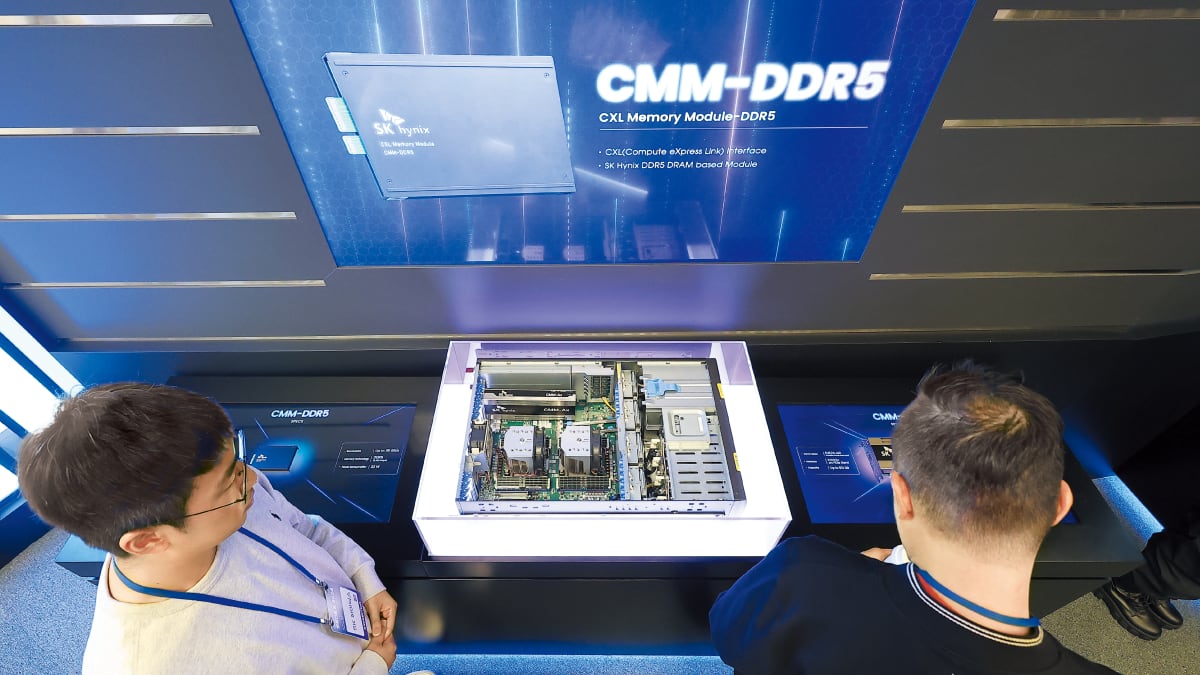
With growing rivalry in the high-bandwidth memory (HBM) market, top memory chip manufacturers are broadening their AI semiconductor plans to incorporate Compute Express Link (CXL), a sophisticated memory connectivity solution. This move mirrors rising requirements from major tech companies for cutting-edge AI-driven data centers, where handling large amounts of data effectively is now more crucial than ever before.
The servers operating within these data centers usually include various types of semiconductor parts such as central processing units (CPU), graphics processing units (GPU), and dynamic random-access memory (DRAM). The Compute Express Link (CXL) is an advanced interface created to enhance data exchanges amongst these elements. This technology allows for improved performance using fewer chips, which can lead to reduced infrastructure expenses. An industry insider commented: "Not only does it increase memory capability, but it also dramatically enhances the speed at which information moves between different semiconductor devices." That’s why, alongside High Bandwidth Memory (HBM), it stands out as one of the key technologies under close observation during this age of artificial intelligence.
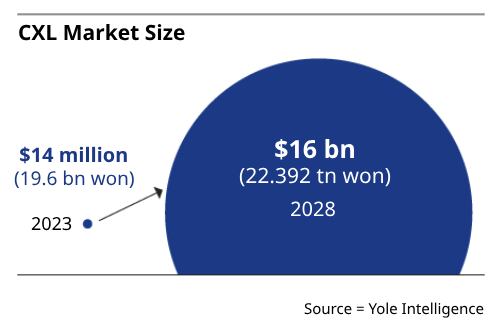
Samsung Electronics and SK Hynix from South Korea, along with the United States-based Micron Technology, which is the newest player among these top three memory manufacturers, are stepping up their initiatives to secure an early lead in the CXL memory sector. Market analysis company Yole Intelligence forecasts that the worldwide CXL market will expand significantly, jumping from $14 million in 2023 to approximately $16 billion by 2028.
At Cxl DevCon 2025, which took place on April 29 in California, Samsung Electronics and Sk Hynix showcased their most recent CXL advancements and research findings. This conference, now in its second year, is organized by the CXL Consortium, an international group comprising various semiconductor firms.
During the conference, Samsung demonstrated their memory pooling technology, utilizing CXL to connect several memory modules into one unified resource pool. This allows users to dynamically manage and assign memory assets according to requirements. As a pioneer in this area, Samsung created the world’s first CXL-driven DRAM back in May 2021. By 2023, they launched a 128GB DRAM module compliant with the Cxl 2.0 specification, achieving successful client verification before the close of the year. Currently, Samsung is gearing up to complete testing for a 256GB variant. "To prevent losing momentum similar to what happened in the HBM sector, Samsung aims to dominate the CXL marketplace," noted someone familiar with the industry.
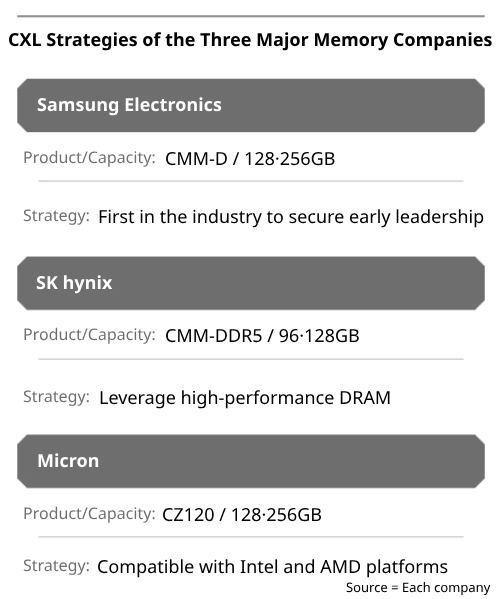
SK hynix, leveraging its strong position in High Bandwidth Memory (HBM), aims to extend this advantage into the Compute Express Link (CXL) domain, with an emphasis on developing high-performance Dynamic Random Access Memory (DRAM). The firm successfully concluded client verification of a 96-gigabyte DDR5 DRAM module compliant with the CXL 2.0 specification on April 23rd. As stated by a spokesperson from the corporation: "In server applications, this particular model offers a fifty percent increase in storage capacity along with thirty percent greater bandwidth than conventional DDR5 models." This innovation has the potential to significantly cut down operational expenses for data centers. Additionally, SK hynix is working towards validating a larger-capacity version at 128 gigabytes.
Last year, Micron Technology, ranking as the globe’s third-biggest producer of memory chips, started implementing CXL 2.0-driven memory expansion modules, stepping up their efforts to narrow the tech divide with competitors like Samsung and SK Hynix.
The emergence of CXL coincides with a larger shift in AI development—from approaches focused heavily on training to ones driven more by inference. Up until now, AI effectiveness was primarily determined by the amount of data a model could process during the training period. During this phase, hardware configurations including GPUs coupled with HBM, similar to what you find in NVIDIA’s AI accelerators, were preferred.
Currently, the emphasis has shifted towards inference-focused AI models. Unlike traditional ones, these models do more than rely solely on pre-existing datasets; they can create novel outputs via logical deduction even with incomplete information from their initial training phase. Such tasks demand both extensive dataset accessibility and swift, effective computation—a capability precisely catered to by CXL technology. As a result of this escalating requirement for streamlined data management, there is an increasing attraction within the AI industry toward adopting this cutting-edge memory interface solution.
Comments
Post a Comment